Schenectady PD Improved Public Safety From the Sky
A look at the agency’s Drone as First Responder (DFR) program, as told by the transparency dashboard and the sergeant who runs it.
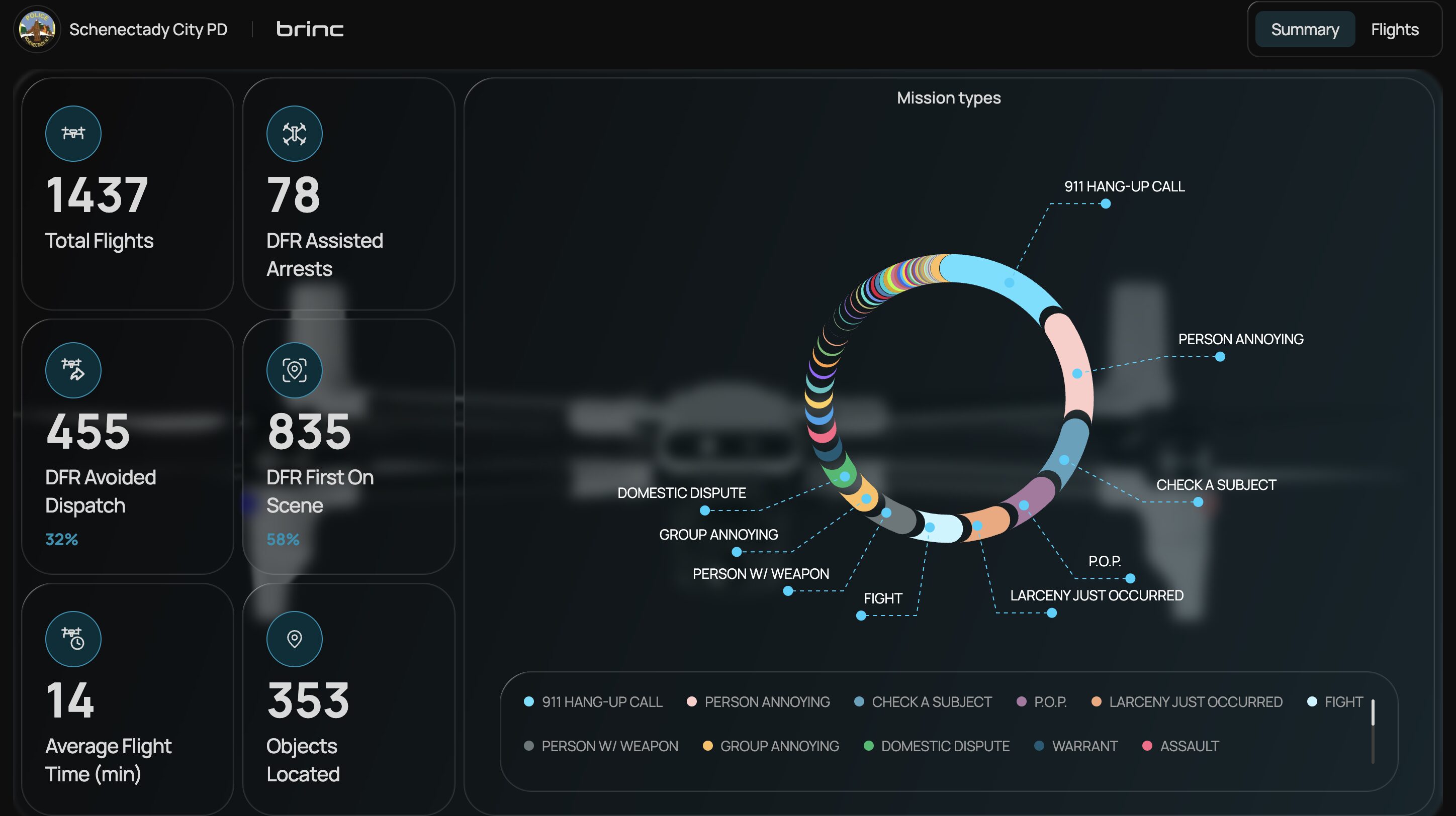
*Screenshot taken as 5/27/2026. Visit here for up-to-date data.
Since they started flying drones as first responders in 2025, the Schenectady Police Department has logged 1,437 flights and arrived first on scene in 835 of them. That’s a 58% rate that has quietly rewritten how the department answers calls.
The numbers on their public transparency dashboard tell the story. 413 dispatches avoided. 62 DFR-assisted arrests. 353 objects located from the air. An average flight time of 14 minutes per call. What started as a niche tool for serious incidents has become an instrumental everyday utility, one that Sergeant Peter Montalto, who runs the program, says has fundamentally changed what efficient policing looks like.
An Aerial View
Helicopters have long given police an aerial view of serious emergency situations, and they remain an invaluable resource for public safety agencies. Drones complement that capability by making an aerial view economically viable for the everyday calls that make up the bulk of police work.
“With DFR, we can basically do the same thing as the helicopter, but we can use it for everything,” says Sergeant Montalto. “We don’t have to reserve it just for a serious robbery or homicide. It’s just a lot more cost effective. We can put it up all day and clear calls with it.”
The shift from “in case of emergency” to “always available” is what produced the dashboard’s most conspicuous number: 835 calls where the drone was first on scene. That means that in more than 58 of every 100 dispatches that involve a drone, the eyes in the sky beat the police cruiser to the scene.
Now, it’s important to remember that this is a model of deployment that won’t work for every agency, but has worked well for Schenectady where they’ve resourced their drone program with the goal of clearing calls.
All About Efficiency
The dashboard shows 455 avoided dispatches at a 32% rate. So nearly one third of the time the drone is launched, an officer never has to physically respond. Property checks, 911 hang-ups, and other low-risk incidents that used to take up much of an officer’s day now take a few minutes of flight time and no ground response.
Says Sergeant Montalto: “We’re there in two minutes, we check, and we’re out. And that officer is freed up to do something else. It just adds up across call after call after call.”
The downstream effect lands directly on residents.
“It just makes us more efficient,” says Sergeant Montalto. “Because officers aren’t spending time on the calls we handle, they can take other calls, which reduces our pending queue and wait times for citizens.”
And when ground response is needed, the drone still buys precious minutes.
“We can start heading to a call before the dispatcher even puts it into the computer. We’re already a few minutes ahead of the officer, and we don’t have to follow streets, red lights, or traffic.”
Better Information
It’s not just efficiency that DFR provides. The dashboard’s mission-type breakdown is heavy on property checks (such as suspected burglaries), but also fights, larcenies, persons with weapons, and domestic disputes. Why? Because a drone provides better information for responding officers.
“We’re the witness in the sky,” says Sergeant Montalto. “We give officers the information they need to do their job safely and effectively before they arrive or while they’re on scene.”
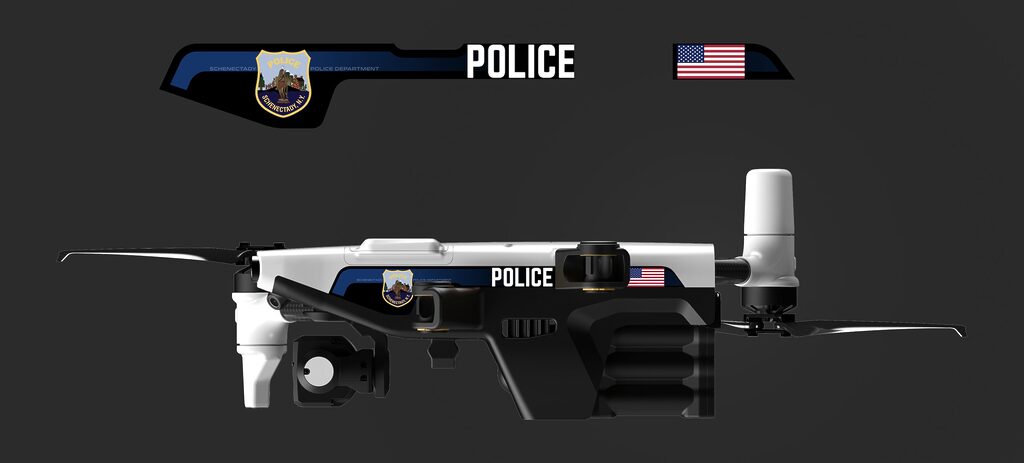
This includes capabilities Montalto admits he undervalued at first. For instance, the drone’s onboard speaker, originally a footnote in his planning, has turned into one of the program’s most useful tools.
“It’s a lot more useful than you’d expect, even just for minor situations,” he says. “It gets suspects prepped for arrest rather than hiding in a backyard and having an officer stumble on them and end up in a physical fight.”
The thermal camera has been similarly transformative.
According to Sergeant Montalto, “I can switch to thermal even in the middle of the day and pick up squirrels in the woods I couldn’t see through a regular camera. If a suspect is hiding in there, I’d find him.”
Surprise Use Cases
Several of the DFR program’s biggest wins were not in the original playbook. Retail theft is one.
“I didn’t think we’d be using it much for this, but we get tons of retail thefts,” says Sergeant Montalto. “We’ll watch suspects ditch stolen merchandise, put it behind a bush or in a bag and walk away like it’s not theirs. But we have it on video.”
Weapons recovery is another unexpected use case. “We’ve found a lot of handguns with it,” says Sergeant Montalto, referring to some of the 353 objects logged on the dashboard.
What’s Next?
Even with the program’s success, Sergeant Montalto is candid about DFR’s current limitations. Battery life remains the single biggest constraint.
“The most frustrating part is when you’re in the heat of a moment, a suspect is fleeing, and you know you can stay on them, but you don’t have the battery to do it,” he says. “I think Guardian will really solve that problem.”
He’s also looking forward to expanded thermal capability and sees more launch points as a clear path to even bigger numbers next year. “If we could just launch from closer to where the action is, that would help our flight time tremendously,” he says.
The Schenectady transparency dashboard is a public record of what policing looks like when an aerial unit is treated as everyday infrastructure rather than a last resort. Behind the numbers is a police department working faster, smarter, and safer than ever before.